
Smooth admission, no hidden charges
What I like most about BTech at MIT Sikkim is the balance of theory and practical work. Assignments, internal assessments and project work are spread across the semester, so there is no last-minute pressure.

Specialisation: Instrumentation & Control Engineering
Bachelor of Technology under the Work Integrated Learning Programme (WILP) model is built for working professionals and self-employed learners who need genuine flexibility without compromising on academic quality. Spread across 4 years and 140-150 credits, the course focuses on Instrumentation & Control Engineering, so learners build both conceptual grounding and practical, job-ready skills. Admission requires 12th PCM / Diploma + Employment Letter, keeping the entry criteria realistic for learners returning to formal study. On completion, learners are positioned for roles like Instrumentation Engineer (Junior) and Control Systems Associate in sectors including Process Industries and Oil & Gas. With study material, mentoring support, and assessments designed around working schedules, this programme is a credible stepping stone for career growth.
The BTech curriculum is organised into progressive semesters, moving from foundation subjects to applied, specialization-focused papers. Core and elective areas include Instrumentation Fundamentals, Control Systems Engineering, Process Instrumentation, Industrial Automation, taught through recorded lectures, downloadable study material, practical assignments and periodic contact sessions. Learners submit assignments and appear for term-end examinations that test both conceptual understanding and applied problem-solving. Undergraduate learners build up from foundational concepts before moving into applied, specialization-specific coursework.
Take the next step today — our counsellors respond within 30 minutes.
A mix of assignment-based internal assessment and semester-end examinations, with practical vivas or project submissions built in for applied subjects.
Take the next step today — our counsellors respond within 30 minutes.
Graduates of this programme are well positioned to build a career in Instrumentation & Control Engineering-linked roles across growing sectors. Typical career directions include Instrumentation Engineer (Junior), Control Systems Associate, Process Automation Executive, primarily within Process Industries, Oil & Gas, Manufacturing Automation, Power Plants. At this undergraduate stage, BTech builds a solid, job-ready foundation for an early career start in the field.
Process Industries, Oil & Gas, Manufacturing Automation, Power Plants
Rs. 3.2 – 7.5 LPA (varies by engineering branch and employer)
Take the next step today — our counsellors respond within 30 minutes.
Established by State Act
Recognized University
Participating in Rankings
CBCS Structure
Recognized qualification valid for jobs, promotions, and higher studies across India.
Practical, skill-based learning with internships built into many programs.
Modern credit-based structure that matches national education standards.
5% merit scholarships for economically weaker students, plus flexible EMI.
Fill the online enquiry / application form for the 2026 session
Free counselling call — eligibility and specialisation check within 30 minutes
Upload documents (marksheets, ID proof, photograph) for verification
Pay the ₹5,000 registration fee to block your seat
Receive the provisional admission letter and enrolment number
Pay the first-year fee (full or instalment) to confirm admission
Classes begin — LMS/ID card, timetable and student support activated
Documents required: 10th & 12th marksheets, graduation marksheet (for PG), transfer/migration certificate, ID proof and passport-size photographs.
Take the next step today — our counsellors respond within 30 minutes.
What I like most about BTech at MIT Sikkim is the balance of theory and practical work. Assignments, internal assessments and project work are spread across the semester, so there is no last-minute pressure.

Campus environment in Namchi is calm and study-friendly. For BTech students the labs and library resources are more than enough, and the staff is always approachable.
Joining BTech in the founding batches turned out to be an advantage. We get more faculty attention, leadership roles in clubs and direct access to the placement cell.
What I like most about BTech at MIT Sikkim is the balance of theory and practical work. Assignments, internal assessments and project work are spread across the semester, so there is no last-minute pressure.

Campus environment in Namchi is calm and study-friendly. For BTech students the labs and library resources are more than enough, and the staff is always approachable.
Joining BTech in the founding batches turned out to be an advantage. We get more faculty attention, leadership roles in clubs and direct access to the placement cell.
What I like most about BTech at MIT Sikkim is the balance of theory and practical work. Assignments, internal assessments and project work are spread across the semester, so there is no last-minute pressure.
Campus environment in Namchi is calm and study-friendly. For BTech students the labs and library resources are more than enough, and the staff is always approachable.
Joining BTech in the founding batches turned out to be an advantage. We get more faculty attention, leadership roles in clubs and direct access to the placement cell.
What I like most about BTech at MIT Sikkim is the balance of theory and practical work. Assignments, internal assessments and project work are spread across the semester, so there is no last-minute pressure.
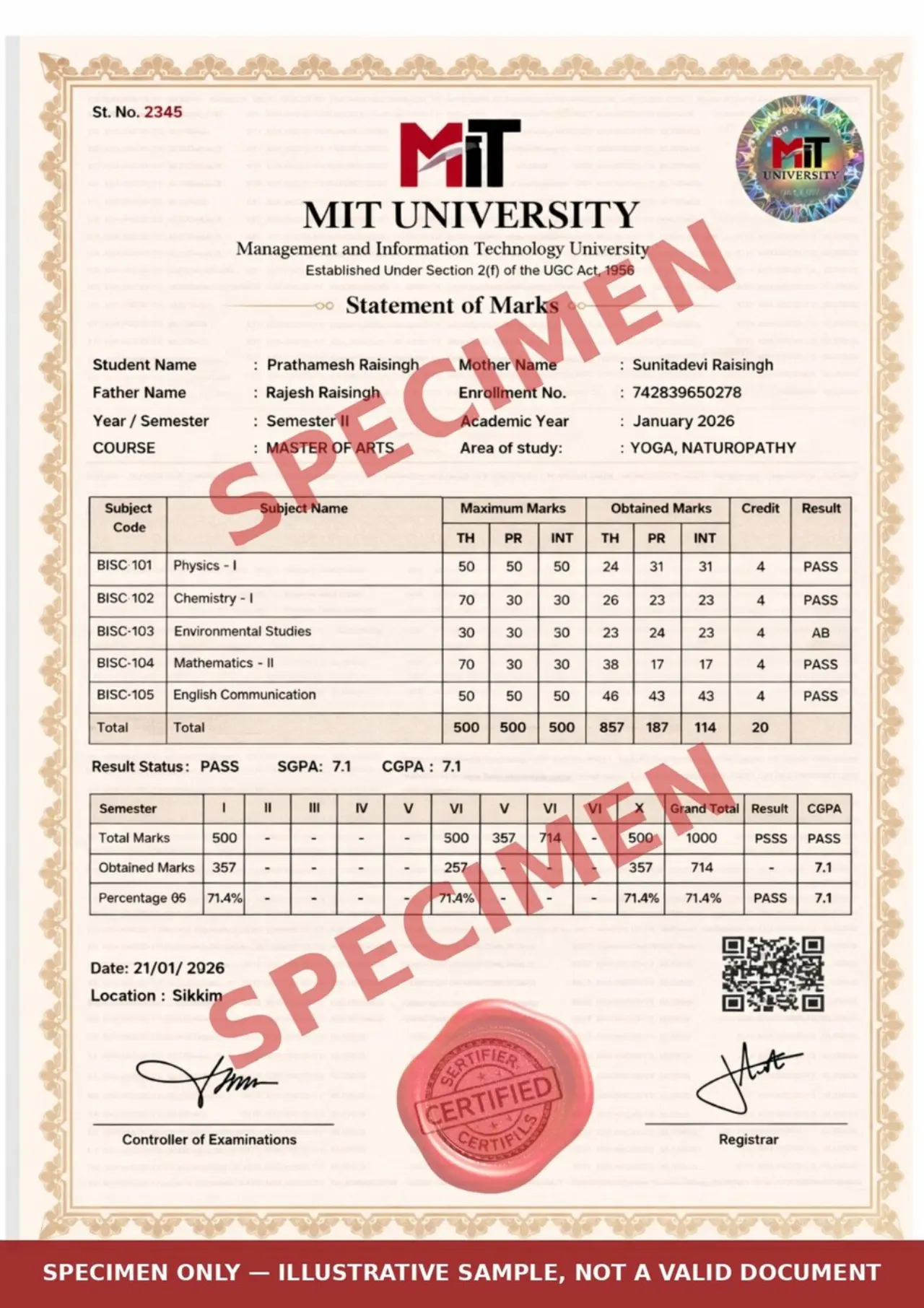
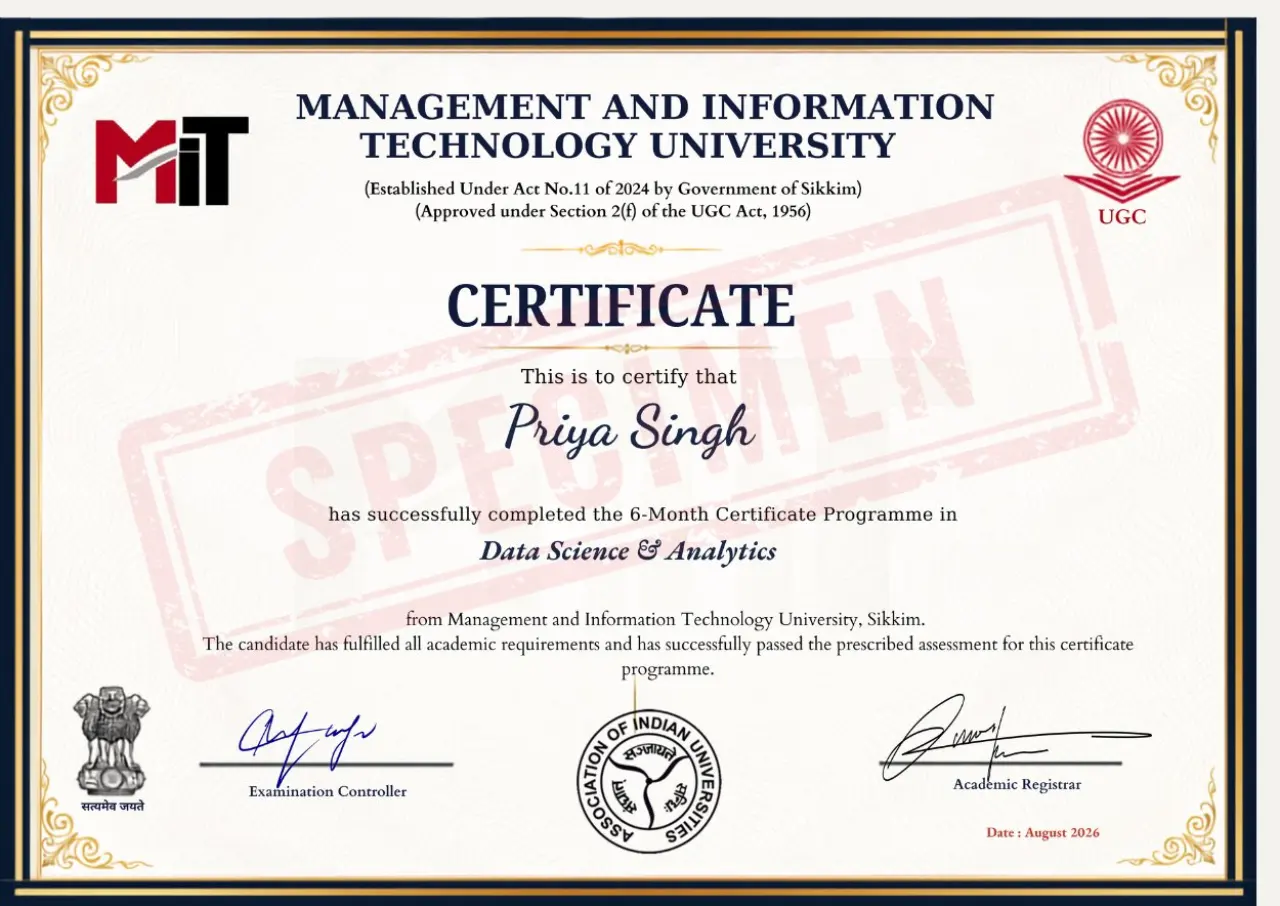
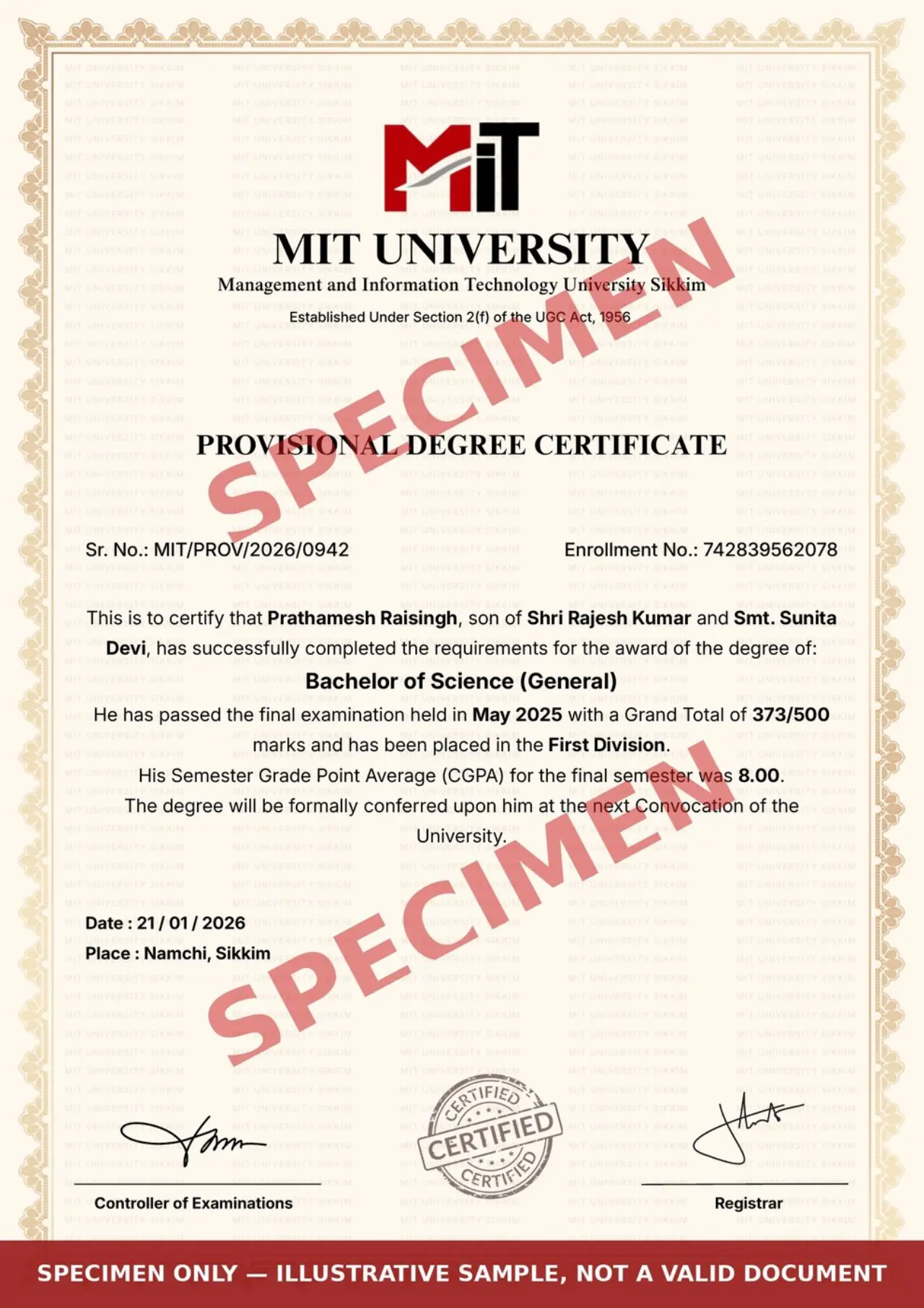
On completing the BTech programme at MIT University Sikkim, students receive official, verifiable documents. Specimen samples are shown below — names, marks and dates are fictitious and the images are watermarked; they are invalid for any official use.

Provisional Degree Certificate
Issued after successful completion of the programme, bearing the university seal and signatures.

Statement of Marks
Semester-wise marksheet showing subjects, credits and grades under the CBCS / NEP 2020 framework.

Programme Certificate
Landscape certificate awarded on completion of certificate and diploma programmes.
Specimen only — these samples cannot be used as proof of education. Original documents are issued solely by the university's examination division.
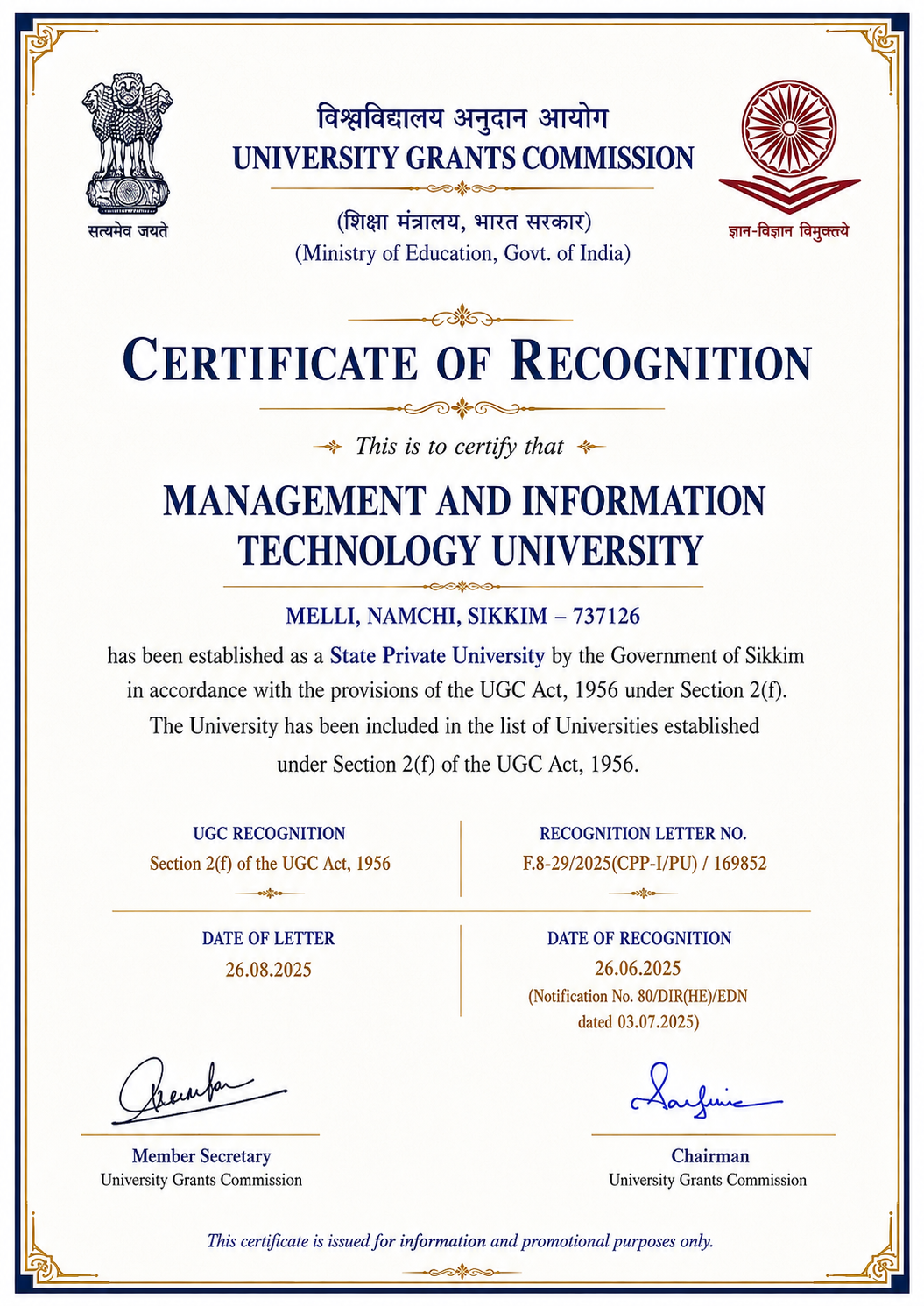
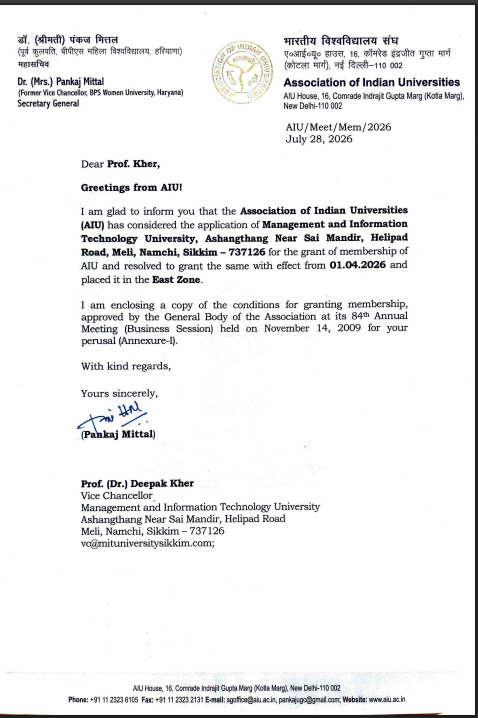
View All SamplesYour BTech degree is backed by these official recognitions. Below are the actual recognition documents issued to MIT University Sikkim.

UGC Certificate of Recognition
Established as a State Private University by the Government of Sikkim under Section 2(f) of the UGC Act, 1956.
View UGC Letter (PDF)
AIU Membership Letter
Association of Indian Universities (AIU) membership granted with effect from 01.04.2026, East Zone.
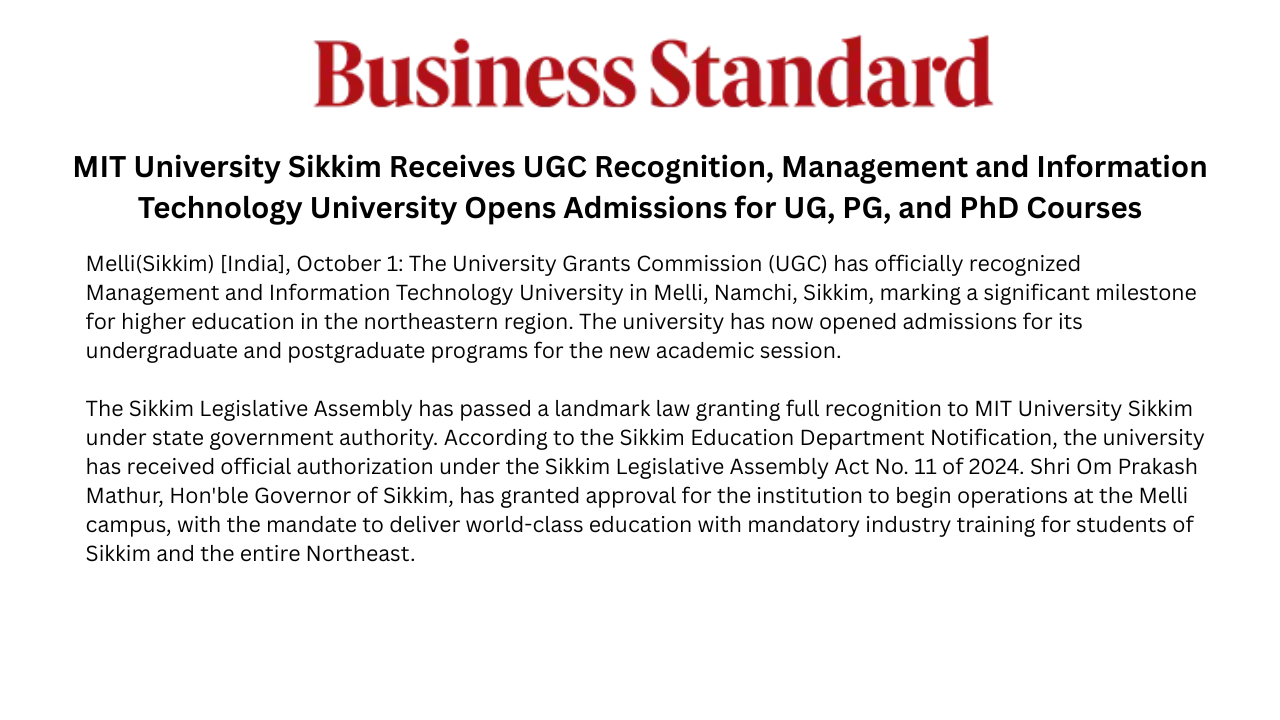
View AIU LetterNational press coverage and official engagements backing the BTech programme.